- Union Minister outlines roadmap for AI, semiconductors, electronics and digital innovation under Viksit Bharat 2047
- Hyderabad positioned as a key technology and manufacturing hub; Kishan Reddy calls for balanced regional growth
THE JOURNALIST POST | Hyderabad | July 11, 2026 : Union Minister for Electronics & Information Technology, Railways and Information & Broadcasting, Ashwini Vaishnaw on Saturday called upon India’s information technology industry to transition from a traditional software services model to an “AI as a Service” model, stating that Artificial Intelligence, semiconductor manufacturing and electronics will drive the country’s next phase of economic growth under Prime Minister Narendra Modi’s vision of Viksit Bharat 2047.
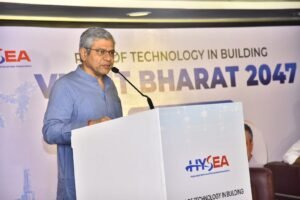
Addressing an Industry Leaders’ Townhall on “The Role of Technology in Building Viksit Bharat 2047”, organised by the Hyderabad Software Enterprises Association (HYSEA) in Hyderabad, the Minister said India’s globally trusted technology ecosystem and highly skilled workforce provide a strong foundation for becoming a global leader in AI-powered digital services. The programme was followed by a roundtable interaction with industry leaders and was attended by Union Minister for Coal and Mines G. Kishan Reddy.
Highlighting the rapid evolution of Artificial Intelligence, Vaishnaw said every new AI model creates fresh opportunities for innovation and business transformation. He urged Indian IT companies to move beyond the Software-as-a-Service (SaaS) model and embrace AI-driven solutions capable of delivering greater value across industries.
The Minister stressed that this transformation must be supported through close collaboration between academia and industry. He noted that NASSCOM, in partnership with the Government, has developed a comprehensive Artificial Intelligence curriculum, which has been shared with the Ministry of Education and AICTE to equip students with cutting-edge AI skills.
Speaking on India’s growing semiconductor ecosystem, Vaishnaw said the country’s long-standing ambition of becoming a semiconductor manufacturing hub has begun to materialise under the leadership of Prime Minister Narendra Modi. He revealed that 12 semiconductor manufacturing facilities are currently under various stages of development, with three plants already producing semiconductor chips for export to Japan, Europe and domestic markets.
He added that India’s expanding semiconductor design ecosystem and the global shortage of skilled professionals present enormous opportunities for Indian companies. To strengthen future talent, the Government has made advanced semiconductor design tools available to 315 universities across the country.
On electronics manufacturing, the Minister said India has witnessed unprecedented growth, with mobile phones emerging as the country’s largest export category during the previous year. He projected that India’s electronics manufacturing industry would expand from the current ₹13 lakh crore to nearly ₹20 lakh crore in the coming years.
Highlighting Telangana’s contribution, Vaishnaw said the Central Government has supported the establishment of 104 electronics manufacturing companies in the state, sanctioned four Electronics Manufacturing Clusters (EMCs) and established a Common Facility Centre (CFC) to strengthen the electronics ecosystem.
Focusing on infrastructure development, the Union Minister described Hyderabad as one of India’s fastest-growing technology destinations. He announced that three bullet train corridors are planned for Hyderabad, which would significantly enhance connectivity and support the city’s emergence as a major centre for innovation and economic development.
Vaishnaw also highlighted the substantial increase in railway investments in Telangana. He said that while the undivided Andhra Pradesh received around ₹880 crore annually for railway development during the UPA government, Telangana alone is now receiving more than ₹5,400 crore annually. He added that nearly 40 railway stations in Telangana are being modernised under the Amrit Bharat Station Scheme, which forms part of the nationwide redevelopment of over 1,300 railway stations.
He further stated that Hyderabad has emerged as one of India’s most important centres for technology-driven growth, making significant contributions in Artificial Intelligence, semiconductor manufacturing, Kavach railway safety technology, visual effects (VFX), digital public infrastructure and innovation.
The Minister noted that India’s digital transformation over the last decade has established the country as a global leader in Digital Public Infrastructure. He pointed out that the Unified Payments Interface (UPI) has processed transactions worth more than ₹314 lakh crore, while indigenous 4G and 5G technologies and affordable digital services continue to accelerate economic growth and innovation across sectors.
Speaking on the occasion, Union Minister for Coal and Mines G. Kishan Reddy stressed that Telangana’s development should extend beyond Hyderabad. He called for tier-II cities such as Warangal, Karimnagar and other urban centres to emerge as investment, manufacturing and employment hubs, ensuring balanced regional development across the state.
He also highlighted the redevelopment of Secunderabad and Nampally railway stations, expansion of railway infrastructure and the achievement of 100 per cent railway electrification, stating that these initiatives would strengthen connectivity and support Hyderabad’s long-term economic growth.
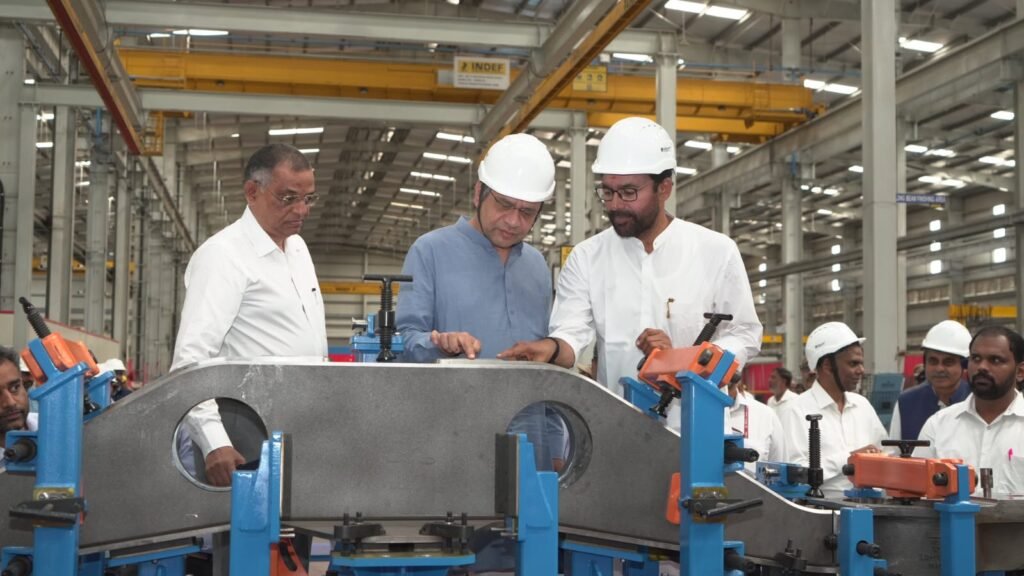
Later, Union Ministers Ashwini Vaishnaw and G. Kishan Reddy visited the Medha Bogies Factory at Kondakal and Medha Servo Drives Private Limited on Fab City Road. They reviewed manufacturing operations, assessed technological capabilities and safety systems, interacted with officials and employees, and inspected facilities ahead of the commissioning phase.